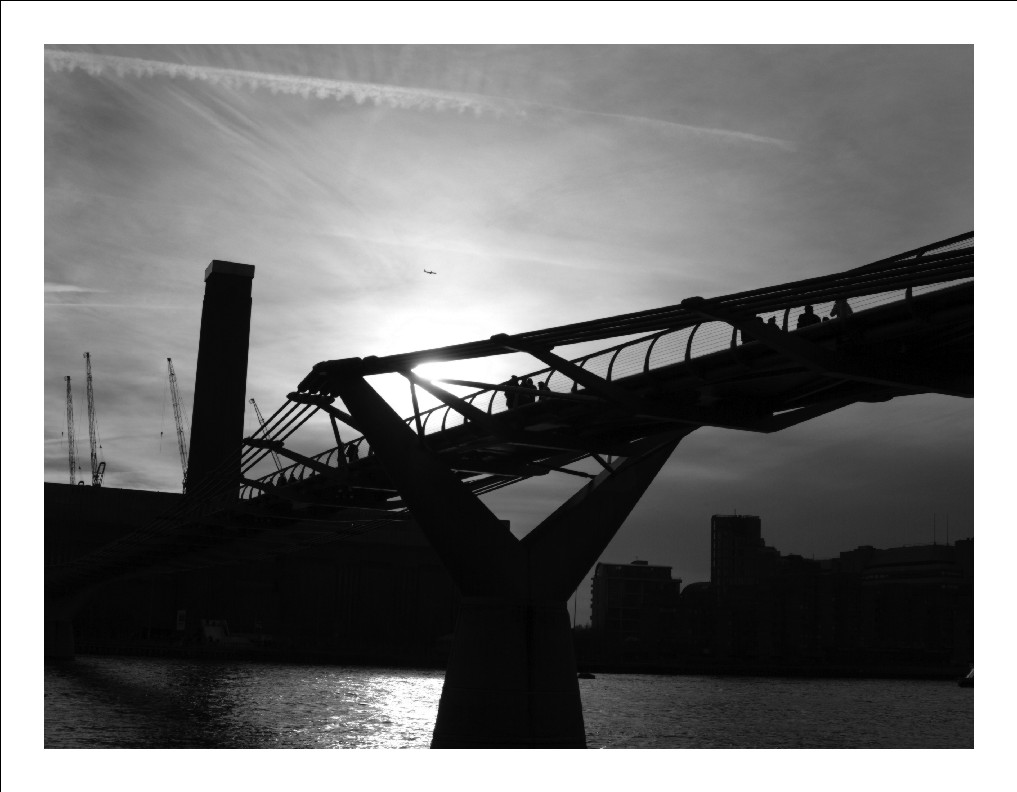
Bridge Incidents:
When the bridge re-opened a a national newspaper photographed a woman in a bikini holding two plates of jelly on it to see if the wobble had really been fixed.
Whilst the repair work was being done a bale of hay was hung from the bridge in order to warn passing boats of the construction work going on
.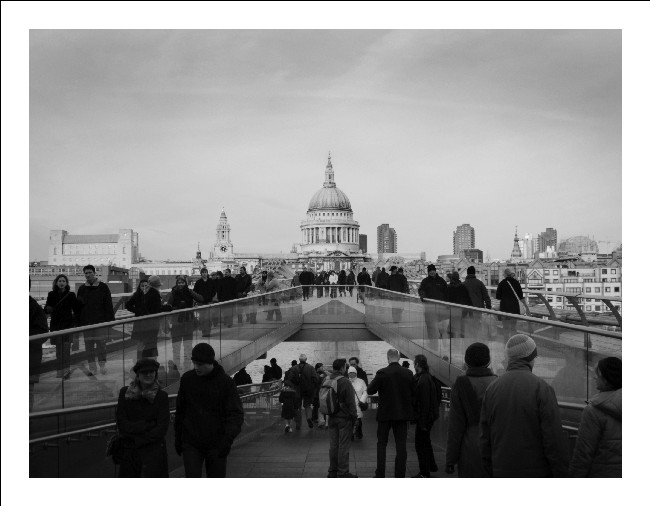
From
Cross River Traffic:
Those
lucky enough to have been crossing the bridge on 21 September 2004 at 5PM
would have been treated to a Native American in full head-dress blessing
the waters from on the bridge. Then again if any waters were in need of
ritual blessing by a lunatic in feathers then the Thames would certainly
qualify. Millennium Bridge Photos copyright Chris Cooke
Millennium Bridge
London is peculiar. The city waits 100 years for a new bridge, then three appear almost at once. This one is the most (in) famous. It opened to huge excitement and large crowds only promptly to close because it was too popular. Organisers had estimated fewer than 10,000 people would cross it on the first day in June 2000, but ended up with more 100,000. This volume of people tramping across it on the opening weekend set up a rhythm that caused the bridge to move on its support and, but for this huge human wave, the wobbling bridge might never have swayed its 70mm. Although the nausea-inducing 'ride' as some described it (in fact it was light, a mild intoxication with your feet going slightly awry, and not unpleasant at all) never threatened to undermine its structural integrity, the bridge's excessive movement forced designers back to their drawing boards. Someone even came up with a mathematical formula to explain it, F=KxV. F is sideways force, V is the sideways force of bridge on pedestrians. K is the mathematical constant.
The bridge was designed by Foster Partners with collaboration from sculptor Anthony Caro, and built by engineers Ove Arup and Partners. Collectively they won a competition in 1996 to erect the 320 metres long bridge. It is a very shallow suspension bridge with two Y-shaped armatures supporting eight cables that run along the sides of the 4-metre-wide deck. Steel transverse arms clamp onto the cables at 8-metre intervals to support the deck itself. The cables never rise more than 2.3 metres above the deck making for an oxymoronically flat (or nearly flat) suspension bridge that allows those crossing pedestrians better views of the river and surrounding buildings. The aim was 'a slender arc across the water', by day a 'thin ribbon of steel and aluminium' and by night 'a glowing blade of light'.